as mentioned in At the centre of many controversies for being a platform being used to spread 'fake news', WhatsApp is now suggesting ways to combat this menace. In the announcement, which was also published in leading dailies, the company has suggested different ways to the users for identifying accuracy of the information. The company's reply came after the respective ministry issued a warning to WhatsApp in the wake of killings taking place across the country due to rumours that circulate via the platform. Five people were lynched to death by villagers in Maharashtra's Dhule district after videos of child lifters were actively circulated on a WhatsApp group. (This story has not been edited by Business Standard staff and is auto-generated from a syndicated feed.)
![WhatsApp fights fake news with Indian newspaper ads]()
![WhatsApp fights fake news with Indian newspaper ads]()
collected by :Molly Tony
WhatsApp fights fake news with Indian newspaper ads
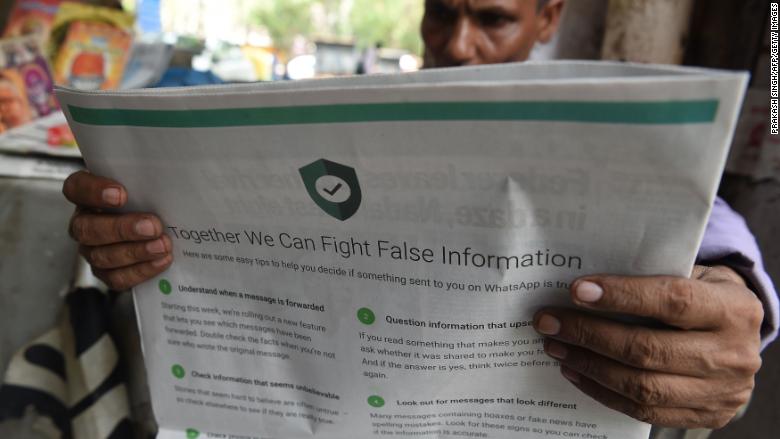
Prakash Singh / AFP/Getty ImagesWhatsApp took out newspaper ads to combat fake news in India on Tuesday, after rumors sparked the lynching of five men. The full-page ads, which ran in English, Hindi and other languages in daily papers, include tips for spotting fake news messages on WhatsApp. Readers are advised to check if a message has been forwarded -- WhatsApp is rolling out a new feature to help people identify forwarded messages. WhatsApp, fake news and gadgets: 5 interesting trends in digital news. Fake news on WhatsApp provokes lynchings in India: Five men murdered when a village thinks a video warning against child abduction shows a real kidnapping.Fake News: WhatsApp offers tips to spot fake news after Indian murders - The Economic Times
as informed in "We are starting an education campaign in India on how to spot fake news and rumours," a WhatsApp spokesman said in a statement. Facebook's WhatsApp messaging platform on Tuesday published advertisements in key Indian newspapers to tackle the spread of misinformation, its first such effort to combat a flurry of fake messages that prompted mob lynchings.Beatings and deaths triggered by false incendiary messages in India, WhatsApp's biggest market with more than 200 million users, caused a public relations nightmare, sparking calls from authorities for immediate action. "Together we can fight false information," read full-page advertisements in some top English language-newspapers, part of a series that will also feature in regional-language dailies.It urged users to check information before sharing it and cautioned them about the spread of fake news "We are starting an education campaign in India on how to spot fake news and rumours," a WhatsApp spokesman said in a statement. "Our first step is placing newspaper advertisements in English and Hindi and several other languages. We will build on these efforts.WhatsApp is using newspapers to fight fake news in India
WhatsApp is using old media to tackle its misinformation problem in India. The messaging service, owned by Facebook (FB), took out full-page ads in leading English and Hindi newspapers on Tuesday, giving readers 10 tips to spot messages that might be fake. WhatsApp, which has more than 200 million users in India, is also rolling out several new features to stop the spread of fake rumors. They include a service it is testing only in India that will show users when a message has been forwarded rather than composed by the sender. Related: WhatsApp fights hoax messages in India after rumors led to killingsOther big tech firms around the world are also trying to combat misinformation, including Facebook.WhatsApp fights fake news with Indian newspaper ads
Prakash Singh / AFP/Getty ImagesWhatsApp took out newspaper ads to combat fake news in India on Tuesday, after rumors sparked the lynching of five men. The full-page ads, which ran in English, Hindi and other languages in daily papers, include tips for spotting fake news messages on WhatsApp. Readers are advised to check if a message has been forwarded -- WhatsApp is rolling out a new feature to help people identify forwarded messages. WhatsApp, fake news and gadgets: 5 interesting trends in digital news. Fake news on WhatsApp provokes lynchings in India: Five men murdered when a village thinks a video warning against child abduction shows a real kidnapping.Fake News: WhatsApp offers tips to spot fake news after Indian murders - The Economic Times
as informed in "We are starting an education campaign in India on how to spot fake news and rumours," a WhatsApp spokesman said in a statement. Facebook's WhatsApp messaging platform on Tuesday published advertisements in key Indian newspapers to tackle the spread of misinformation, its first such effort to combat a flurry of fake messages that prompted mob lynchings.Beatings and deaths triggered by false incendiary messages in India, WhatsApp's biggest market with more than 200 million users, caused a public relations nightmare, sparking calls from authorities for immediate action. "Together we can fight false information," read full-page advertisements in some top English language-newspapers, part of a series that will also feature in regional-language dailies.It urged users to check information before sharing it and cautioned them about the spread of fake news "We are starting an education campaign in India on how to spot fake news and rumours," a WhatsApp spokesman said in a statement. "Our first step is placing newspaper advertisements in English and Hindi and several other languages. We will build on these efforts.WhatsApp is using newspapers to fight fake news in India
WhatsApp is using old media to tackle its misinformation problem in India. The messaging service, owned by Facebook (FB), took out full-page ads in leading English and Hindi newspapers on Tuesday, giving readers 10 tips to spot messages that might be fake. WhatsApp, which has more than 200 million users in India, is also rolling out several new features to stop the spread of fake rumors. They include a service it is testing only in India that will show users when a message has been forwarded rather than composed by the sender. Related: WhatsApp fights hoax messages in India after rumors led to killingsOther big tech firms around the world are also trying to combat misinformation, including Facebook.collected by :Molly Tony
Comments
Post a Comment